11 November, 2013

The Redneck's Guide to Art


11 November, 13

This is my first blog that is written in both English and Spanish. Many thanks to Google Translate and my friends who have helped me learn this fascinating language. I apologize in advance for butchering it.


Yesterday, Susan and I went to Mercadona and MercaChina to buy a few things. While we were driving, we came across a graffiti artist. I have been fascinated by this art form in La Alberca ever since we got here. Really, ever since I was a kid, when I would see trains rumbling down the tracks laden with colors and words that were some sort of verbal and visual puzzle. 

In June, our family traveled to Germany. We saw many examples of amazing street art there. The Berlin Wall that separated East from West was a grand canvas for the West. Over 28 years the wall crumbled under the weight of freedom, signified by graffiti. Now the only sections of wall that still stand are left as a gallery for street art.

A big part of the attraction for me is the fact that graffiti is against the law. How can a painter complete these huge pieces over two or three days without being caught? Surely the police could see the work in progress. The painters are like Robin Hood, stealing walls from the rich and giving art to the poor. Instead of a sword, they have a paint brush or aerosol can. 

One painter here has captured my imagination. His nom de peinture is "Dolor", which means "pain" in English. What is his story? Why would he call himself Pain? When I ride to the mountains on my bicycle, I see many examples of his work on the streets. One street in particular is tagged with Dolor on both ends of it. It is a short street, and I call it the Street of Pain. This is a double entendre, because it is at the end of my rides, and I am usually in a great deal of pain when I finally get to the street. 

My first impression of graffiti was one of disdain, because I didn't understand it. I didn't understand art in general. I am a Redneck, after all. Now I think I like it for the same reason I like "Breaking Bad" and all the sports sponsored by Red Bull. They are counter-cultural, like me. Walking against the herd reveals "the why" about the way we live. Sometimes the normal path is the normal path, simply because nobody bothered to think of another way. We are too often like lemmings, rushing to our death, texting all the while. Sometimes the normal path is there because it is the right path, and the counter-culturalists become roadkill, trampled under foot by the crush of humanity. I guess that makes me a possum.

This graffiti artist, my new friend, walks against the herd. He is not brash or boastful. He doesn't want to fight. He simply walks to give people a vision of what might be possible. He paints the questions we are afraid to ask of ourselves. Maybe his art is a map to guide us. We simply need to learn how to read it.

Ayer Susan y yo íbamos a la mercado para comprar algunas cosas y MercaChina también. Mientras conduciendo a las tiendas, encontramos un pintor de grafiti. He estado fascinado con los ejemplos de grafiti desde llegué en La Alberca. De verdad, comencé a interesar muchas años pasado. Los trenes en la ciudad de mi nació se pintaron con palabras en muchas colores y con formas inusuales.

En junio, mi familia estaba en Alemania. Vimos muchas ejemplos buenos de grafiti. La pared en Berlín que separa este y oeste fue un gran lienzo.

Un parte de el atracción de grafiti para mi es porque la forma de arte es contra la ley. ¿Cómo puede un pintor completar su proyecto sin ser capturados? Necesitas dos o tres días a completar un proyecto. Sin duda, las policías pueden a ver el trabajo antes se finalización.  Los pintores son como Robin Hood, robando las paredes de los ricos y dárselo arte a los pobres. En lugar de una espada, tienen un cepillo de pintura o un bote de aerosol.

Un pintor aquí ha capturado mi imaginación. El nombre es Dolor. Dolor significa “pain” en inglés. ¿Por qué el tiene el nombre “Dolor”? ¿Qué es su historia? Cuando monto en mi bici, veo muchas paredes con “Dolor”. Un calle pequeño en particular tiene “Dolor” dos veces, al principio y al final, en letras grande. Yo lo llamo “El calle de dolor.” Este es un juego de palabras porqué, el calle es la última calle en mi ruta de bicis y normalmente tengo dolor en mi cuerpo. 

Mi primer impresión de grafiti fue desdén porque no lo entendía. No entiendo arte en general. Yo soy un Redneck. Ahora pienso que si me gusta grafiti por la misma razón que me gusta "Breaking Bad" y los deportes patrocinados por Red Bull. Ellos son contracultura como yo. Caminando contra el camino normal del tráfico revela muchas cosas acerca de por qué vivimos como lo hacemos. A veces el camino es el camino único porque nadie tuvo la osadía de preguntar por qué. A veces el camino normal es correcto y las contras se convierten en animales atropellados. Supongo que eso me hace una zarigüeya. 

El pintor de grafiti, mi nuevo amigo, anda contra los gentes, pero no para a luchar. Anda para a dar los gentes un visión de que es posible. Quizás pinta una mapa para nosotros. Simplemente necesitamos a aprender como a leerlo. 


You can find more pics of another artist at http://wakearte.blogspot.com.es/. You can also go to http://jhoez98.blogspot.com.es/2012/07/jhoez-siento.html

08 November, 2013

The Redneck's Guide to Dancing

7 November, 13

One of the most popular images that comes to mind when people think of Spain is a flamenco dancer, twirling her long dress. The other is a bull-fighter. I think the images are really just two sides to the same coin.

Flamenco is one of the most sensual and sexy dances in the world. The only thing missing is the pole. It's not that they are doing anything particularly crude. It is the eyes. The dancers shift seamlessly from passion to anger to trance and back to passion again. You are forced to bend your will to theirs. They will have you. Resistance is futile.

Andalucia, and especially Granada, is the home of some of the best flamenco around. I have a theory about it that is purely anecdotal, but it sounds right to me, so it must be right, right? Granada was dominated by Muslim and arab culture for 1,000 years. Every day, five times a day, somebody would stand at the top of a minaret and call everyone to prayer. We have all heard that haunting sound, a song to be sure, but almost screaming at the same time. That is what a flamenco singer sounds like. I believe that flamenco is the quintessential blending of three cultures--Spanish, arab and gypsy.

(Well, I just read a Wiki article that said the dance originated with gypsies in the Andalusian region, so boo-yah, I nailed it.)

There are three major elements to flamenco. The dance, the guitar and the clap. You can also add a vocalist, but not always. I am a drummer wannabe, so the clapping is fascinating to me. Two or three people will start clapping, often with the dancer accompanying. They are all clapping out a different rhythm and tone. One will clap with hollowed out hands, making a bass tone, and finish by rubbing the hands together as they separate, which makes a swish, sort of like a brush on a high hat. Another will clap with flat hands, which makes that sharp, loud sound, a crack. The guitarist will add taps on his guitar as he strums out a melody. Each percussion is unique from the other ones in tempo and rhythm, but they all blend.

The guitarist plays with all five fingers over the hole, something like a banjo player. Quite often he is the singer as well, almost screaming out a song of deep passion. I remember Antonio taking us to our first flamenco. He translated the lyrics as they were being sung:

"I love you so much, I can drink your blood for wine. I will have you, or nobody will have you."

Now that is passion.

The intensity of the music and lyrics is matched, or maybe surpassed, by the dancer. Both men and women dance flamenco, usually in a round of solos. They command the stage and whip the audience with their eyes, forcing you to watch, to live, to die this moment of unequalled love. The blood drains from your body as she sucks the life out of your very soul.

The woman took her dress in her hands and wielded it like a machete, chopping up the air, as if to say, "Come and get it, if you dare." When she stomped the ground, your soul shook. When she clapped, the thunder reverberated in your spine. Several times in the performance, the woman locked her eyes with mine. I was thrilled and scared at the same time. If she had opened her mouth to expose fangs, I would have left my wife and daughter and run out of the cave, screaming like a little girl. I felt like I was riding a roller coaster without a seat belt, which as many of you know, is one of my favorite things to do.

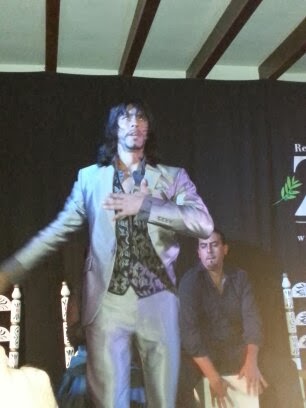
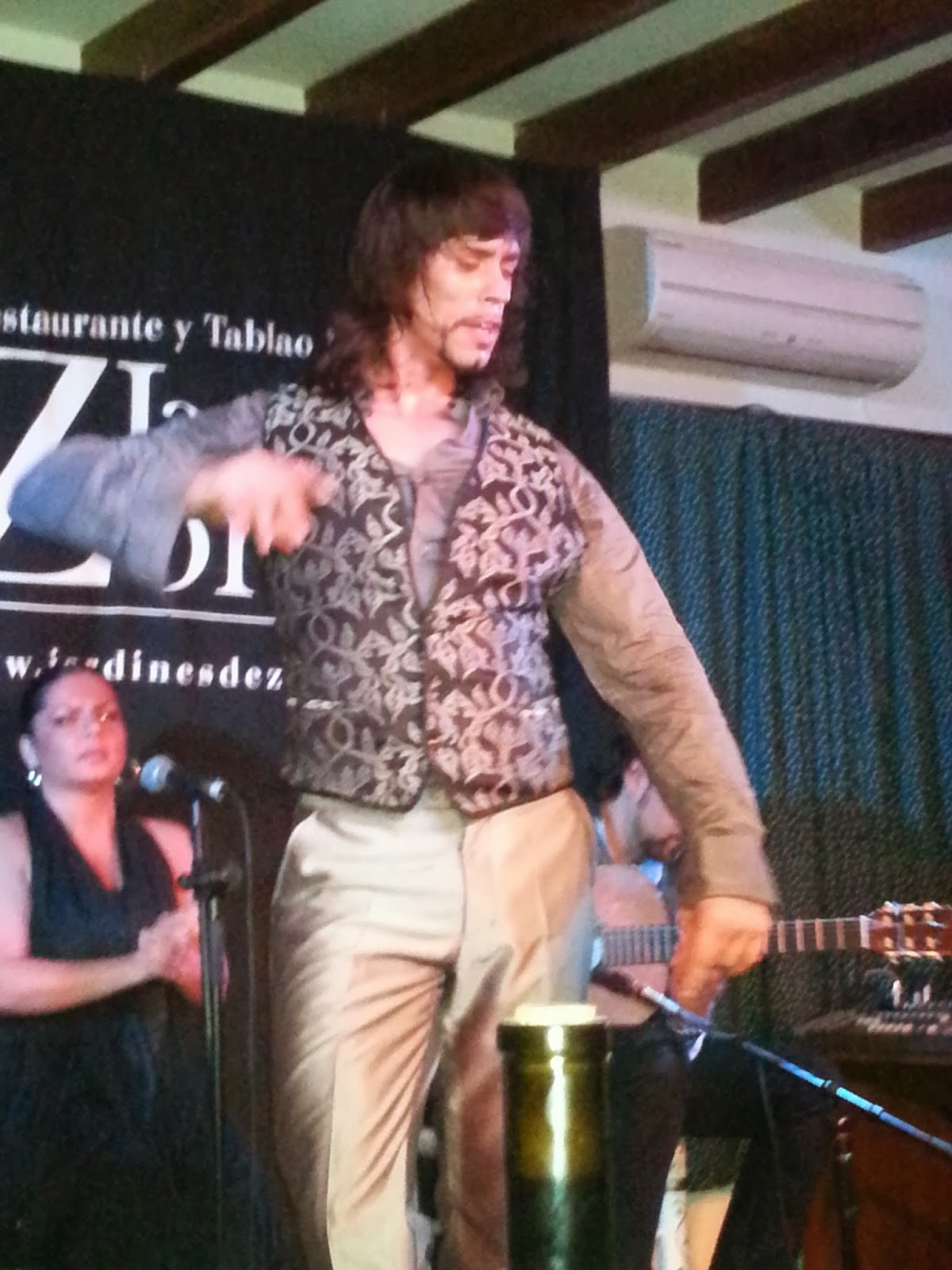
When the man got up to dance, I couldn't help thinking of John Travolta in Saturday Night Fever. He was wearing a shark skin suit, silky looking shirt, opened to show his little bird chest and long stringy, sweat-soaked hair whirling about him like a wrung out mop head. I'm sorry, but I just didn't get the same blood-sucking vibe from the guy. Maybe that's a good thing. He was a great dancer, though. Where the woman was passionate and commanding with her eyes and presence, the man was powerful with his movements and steps. It was a mix of tap dancing and stomp.

The next morning, we were driving around, looking for a place to eat breakfast. Coming around a corner, I almost hit a guy in the crosswalk. He looked up at us with intense disdain. Then I recognized him. It was the dancer. He was outside the cave. In the light. They can move around freely in the daytime! When he was safely on the sidewalk, and we had a clear path of escape, I rolled down the window and called out to him. "Hey, amigo! Baila flamenco, no? Estaba en el restaurane anoche. Muy bien!" I think I told him he was a good dancer, but I might have asked him about his bathroom habits. My Spanish is still pretty lacking. He smiled and said, "Gracias!"

We took off in our car and tried not to hit anybody else. Perhaps the only thing more dangerous than an impassioned flamenco dancer is me driving in a foreign country.


06 November, 2013

La Alhambra

5 November, 13

La Alhambra is one of the most magnificent structures ever built. It is a testimony to Man's ability to erect grand edifices that outlive their original purposes, but continue to live on in other ways. 

Some history is needful here. We remember 1492 as the year Columbus sailed the ocean blue. That is a significant date here as well, but Columbus is more of an afterthought in Spain. The most important events in that time period for Spain were the unification of the country and the completion of La Reconquista.

King Ferdinand of Aragon and Queen Isabella of Castille joined forces, in marriage and in war. They fought against the last Moorish stronghold in Spain, which was Granada. (I am using the historical term, Moors, even though that is not a favorable term today. The proper term would be Muslims, but much of the historical notes about Spain use Moors.) When Granada finally fell, Emir Boabdil, supposedly bowed to kiss the boot of his conqueror, who was on horseback. The general dismounted and gave the Emir a hug instead. 

Under Islamic rule, Muslims, Christians and Jews lived in peace for 800 years in Granada. They were neighbors and friends. The Spanish monarchs respected the Muslim monarchs and vice versa. That respect had eroded somewhat over the last century and culminated with the expulsion or forced conversion of all Muslims and Jews, on penalty of death. This began the Spanish Inquisition. 

Granada was a Moorish stronghold for so long, principally because of La Alhambra. This mighty fortress complex resides over Granada. It is imposing today. I cannot imagine what it must have been like in the Middle Ages. It is beautiful now, smoldering quietly into ruins. One millennium, more or less, makes quite a difference.

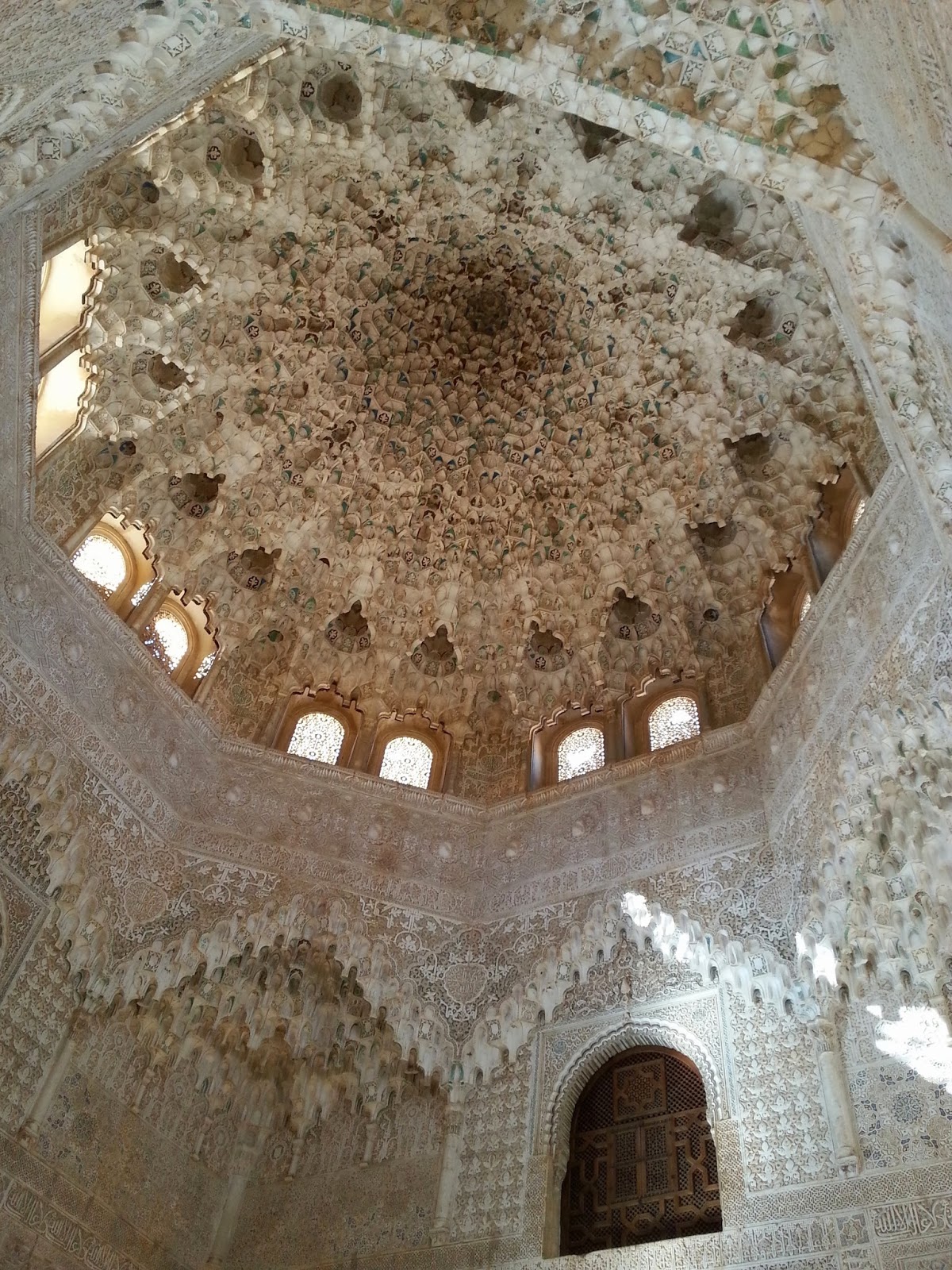
The whole complex is too big to see in one day. We only visited one part, mostly living quarters. The Muslims were known for creating lavish designs and decorating with elaborate geometric patterns. Many inscriptions adorn the palace walls. One said something to the effect, "I am the king. I was put here by God. He is the only ruler over me. I give him the glory. Now look at my clothes. They are so fine, it is obvious that I am the king." Who wouldn't serve a dude like that? Some of the sayings reminded me of Song of Solomon in the Bible. Back in the day, I am sure Solomon was being really sexy, but now his words are just funny:


"Behold, thou art fair, my love; behold, thou art fair; thou hast doves' eyes within thy locks: thy hair is as a flock of goats, that appear from mount Gilead. Thy teeth are like a flock of sheep that are even shorn, which came up from the washing; whereof every one bear twins, and none is barren among them. Thy lips are like a thread of scarlet, and thy speech is comely: thy temples are like a piece of a pomegranate within thy locks. Thy neck is like the tower of David built for an armory, whereon there hang a thousand bucklers, all shields of mighty men. Thy two breasts are like two young roes that are twins, which feed among the lilies." (Song of Solomon 4:1-5)

I just tried to tell Susan her hair was like an old goat, her teeth looked like freshly washed sheep and she was built like a fortress. She evidently had not studied her Bible enough to know this was a high compliment. Please pray for her to get into the Word.

Truly, though, the Muslim kings outdid themselves at La Alhambra. They planted gardens and built fountains in every corner. Evidently there are 17 different classifications for wallpaper, and La Alhambra has all of them. It is a masterpiece. One interesting thing was the fact that the complex changed hands a few times between Christian and Muslim rulers. They each added their own little piece to the puzzle. The Muslims used lavish decorations as a means of giving glory to God, but they would not use any images, because that represented a graven image or idol, which was forbidden. The Christians used more understated architectural features, preferring to appear humble before God, and incorporated figures of humans and animals to reflect God's creation and act as a pictorial explanation of Biblical events. Katherine thought it looked boring. She, and everybody else, liked the Muslim features better. It was interesting to me that both parties were trying to honor God, but that the means of doing so were in direct conflict with each other. 

I asked Katherine what she thought of Muslims before she visited La Alhambra. She said they were just a bunch of crazy people that blew themselves up. Then after her experience in Granada? They were really smart and knew how to build beautiful things. 

Katherine was fascinated by the architecture. She took about 1,000 pictures. I loved the history. Susan was entranced by the grounds, fountains and flora. We all came away with a better understanding and appreciation of another culture. La Alhambra was originally built as a fortress to keep the bad guys out and to provide enjoyment to the good guys. Those roles reversed several times throughout history. Now it is an ambassador of goodwill to all people who come inside its storied walls.

It was a great day.


05 November, 2013

Granada

4 November, 13

Granada is amazing. I had forgotten how beautiful and majestic La Alhambra was. The food is magnificent, and the Spanish is even easier to understand.

About a month ago, we decided to take a family trip somewhere in Europe over this past weekend, since the girls would have a four day weekend break from school. As it turned out, Elizabeth was on a school field trip, so we chose to stay in-country. Somehow we landed on Granada, and I am so glad we did.

Granada is the birthplace of our time here in Spain. Susan lived there for three months in the summer of 1994 with Alicia. Antonio lived on the floor above. We actually drove to the house where they all lived. I was there last in 1998. So much has changed since then, yet so much of Granada is the same.


The new parts of Granada are very modern, even futuristic. They have a fantastic science museum with loads of interactive displays. Katherine is a very tactile person, so she regaled in this environment, touching every display, playing every little game, trying to understand all the puzzling things about the universe and everything in it.  The only part she wasn't too keen on were the reproduction displays. She was not too interested in touching or learning about any of that stuff. They actually had a video of a woman giving birth, from the doctor's perspective.

We learned about chromosomes and starfish, planets and the nervous system, minerals and sound waves. I could have spent a week in that museum. They even had an interactive water system, where you could change the course of water and make water travel up a large augur.

The old sections of Granada are locked in time. The Albayzin, or Gypsy Quarter, is as old as the city. Our first night in Granada, we ate at Casa Juanillo, which is in the heart of Albayzin. Homes and businesses are dug into the mountainside. The businesses have an edifice on the street, and then they either go back into the mountain, or up alongside it. Casa Juanillo is the same restaurant we visited way back in 1998. Susan and I have a wine bottle from C.J. with a candle melted into the top of it. It has been on display in our third bedroom/office ever since. The restaurant has a stunning view of La Alhambra, which is lit up at night.

Katherine had "THE BEST MEAL OF MY LIFE" at C.J.'s. It was a pretty darn good piece of pork that was slow-cooked over a fire and basted in a fig salsa, almost along the lines of a sweet barbecue sauce. We got the basic ingredients for it, so I am adding it to my research for some good Spanish barbecue.

On Saturday we visited the City Center, which is basically a big glob of shops and restaurants. You can go to an H&M department store or to the back alley Moroccan markets, which sell everything, from scarves and leather wallets to tourist trinkets. Susan, being the indecisive one, elected to visit every shop, both modern and ancient. Granada is where she fell in love with Spanish pottery. If you have visited our home in Pinehurst, you have seen examples displayed in our kitchen. Thankfully we came away from those markets relatively unscathed. Driving in Granada was expensive enough, as it turns out.

There are some big signs that tell you NOT to drive along a couple of streets in City Center, unless you are a taxi or bus or you are going to your hotel. Well, quite naturally, I was going to my hotel, which just happened to be about five miles away. I have since come to realize that this section is controlled by the Ticket Witches via camera. They will be sending us a sweet remembrance of our trip to Granada in the form of a multa, costing €200. Actually, our friend Remedio, who loaned us the car, will be receiving this little Grenadine gift. It seems I will never be free of my avowed enemies, the ticket witches. They are everywhere...

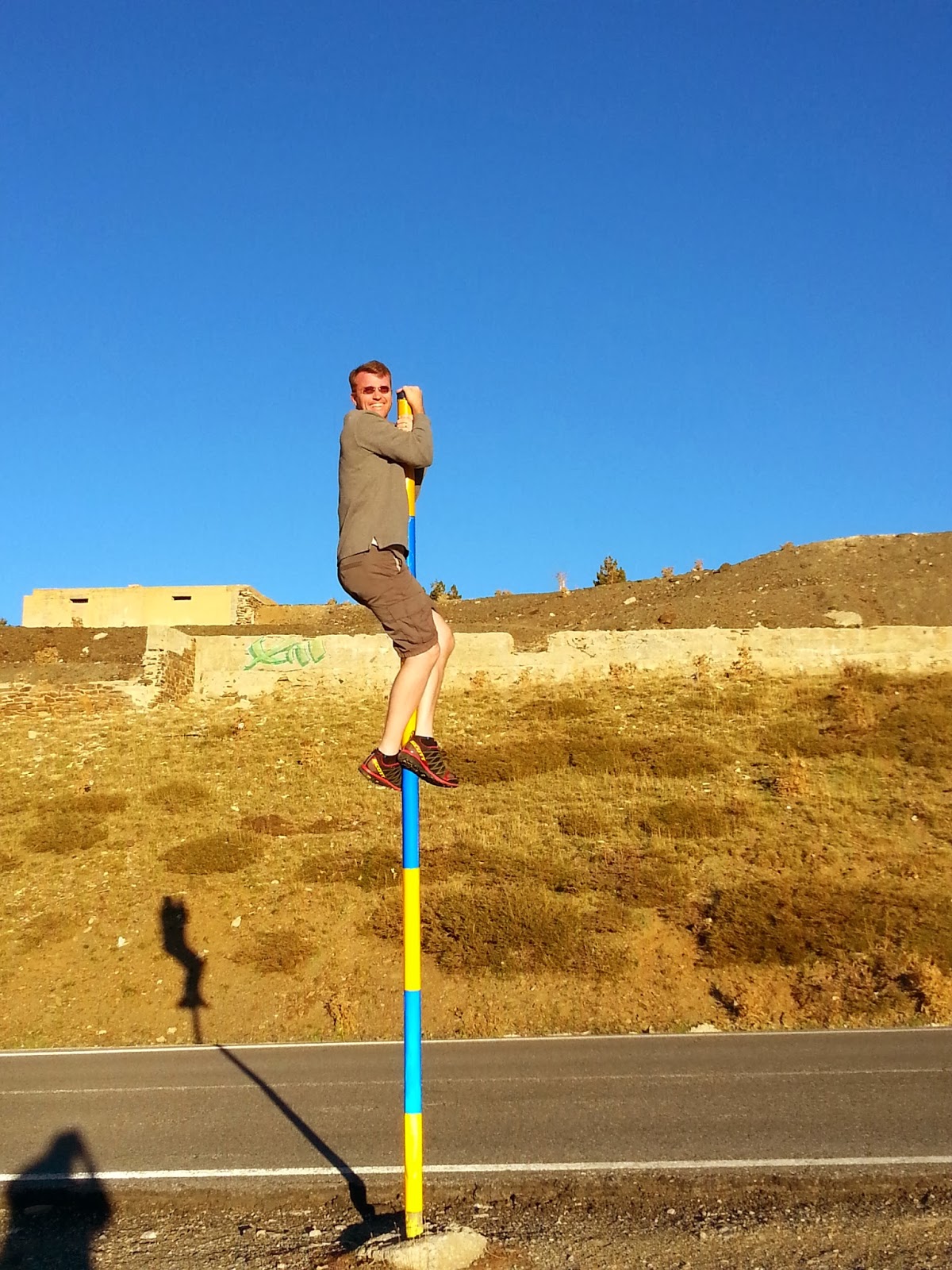
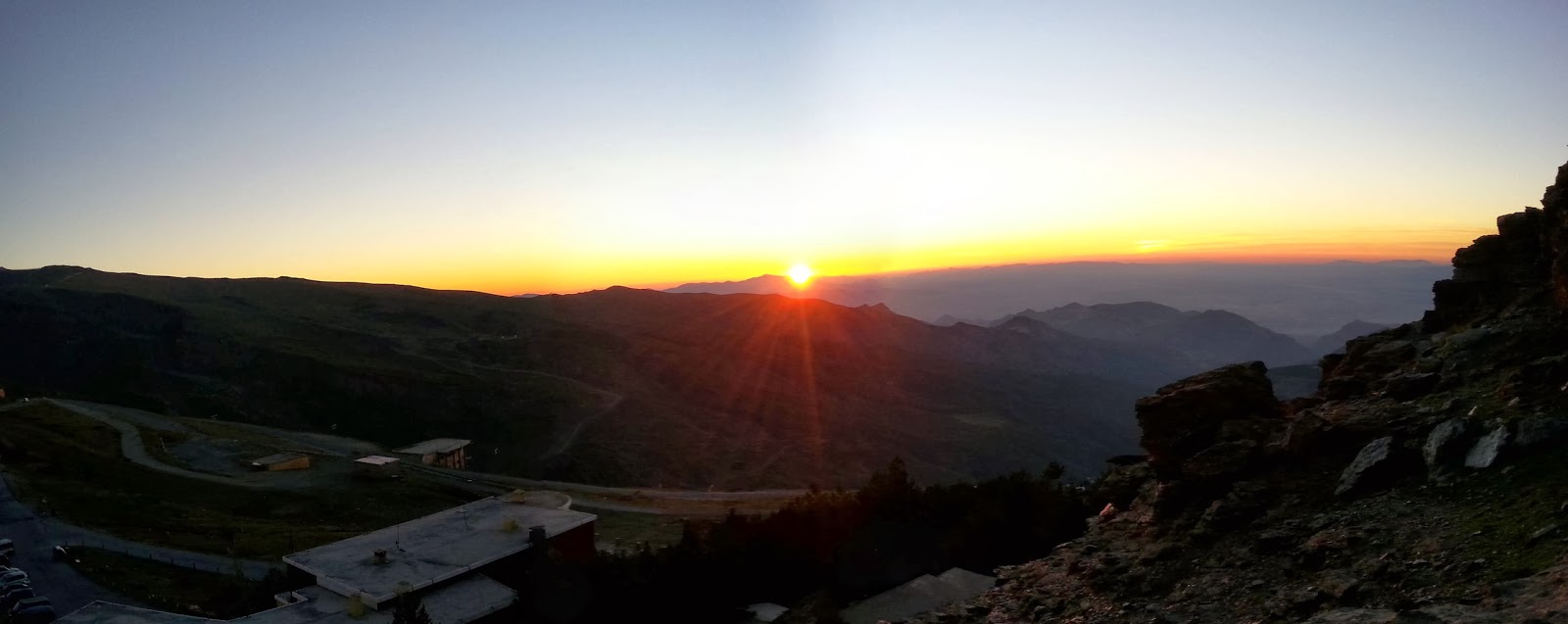
After our trip through town, we headed up the Sierra Nevadas to get some mountain views. We drove up and up and up, until we reached a ski village, then up and up and up some more. The vistas were magnificent. I also encountered about 30 cabras de montaña, which I pursued for half an hour, bagging big daddy in my mind. You can see him at the end one of the videos I am posting. I caught him on the rock ledge, with the sun shining through his horns. He is King of the Hill. The whole scene made me think of my friend George Atherholt, who shot a world record ram. He would stalk the animals for days on end, waiting patiently for the perfect shot.


On Sunday, we finally made it to La Alhambra. This palace has an incredible history. It has changed hands several times over the past 700 years, between the Moor and Christian kings. Granada has a very unique history of peace between Jews, Christians and Muslims, which lasted several centuries. I will write a separate blog about La Alhambra.There is just too much to tell.